

Building AI Capability Through Peer Learning

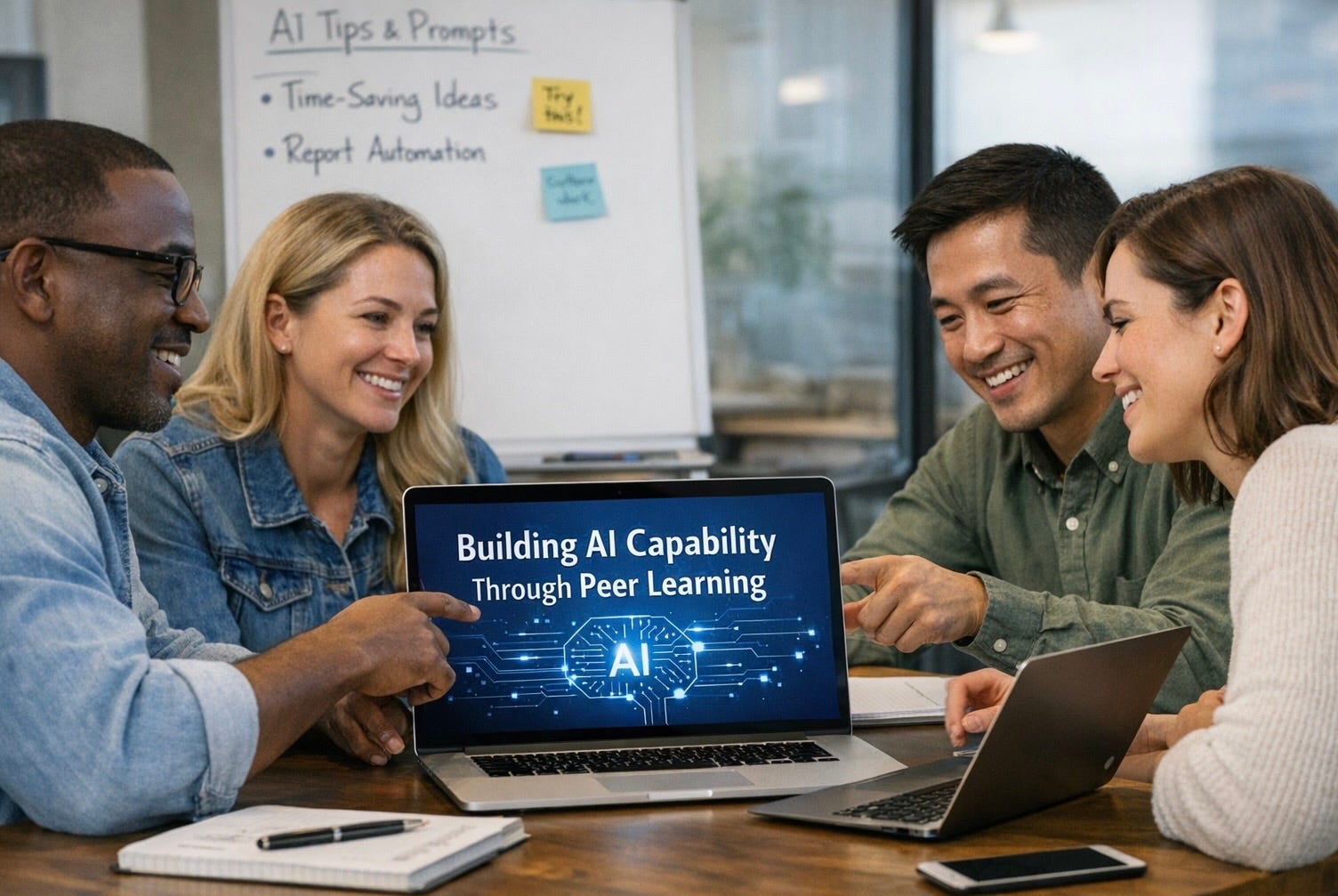
I’ve been researching and writing about AI Adoption, and what drives consistent AI at work here and on LinkedIn. This is a topic that I am so passionate about that I made it part of my final research in Grad school and is now becoming a book. If you want to know first about the book, and get my expanded thoughts on this, comment below and I will add you to the insiders list.
I’ve identified four critical factors for AI Adoption success during my research, one of which is capability, the skills and confidence to use AI effectively. Many organizations try to build capability through formal training programs. But I’ve observed something different in the real world: people rarely build AI capability alone or through courses. They build it together.
Capability grows through conversation. Time and again, I’ve seen a pattern in teams where AI really takes off. Colleagues talk to each other constantly about AI. Someone shares a clever prompt that saved them an hour of work; another demonstrates how they used an AI tool to automate an annoying weekly report. These everyday “hey, check out what I just did!” moments create a ripple effect across the team. When one person shows a win, it sparks others to experiment and share wins of their own. In contrast, teams that only rely on one-off training sessions often struggle to turn knowledge into action. One-and-done AI trainings rarely lead to adoption without follow-up support, you need ongoing reinforcement and a culture of peer support for lasting impact.
Here are some of the other posts I wrote here about the topic:


In fact, the small fraction of companies succeeding with AI tend to encourage people to learn together from day one. Research suggests that organizations which bake peer learning and collaboration into their AI strategy are far more likely to actually improve capabilities – nearly 5 times more likely, according to one leadership survey. Why? Because when people see their colleagues experimenting, something shifts. Trying AI suddenly feels safe. Instead of worrying that they’re the only one who doesn’t “get it,” they realize everyone is figuring this out together. Confidence builds from knowing you’re learning alongside others who are just as curious (and just as unsure) about what’s possible.
This effect has been noted in practice. LinkedIn found that professional networks are the #1 trusted source of advice for workers – 43% of professionals rely on people they know, more than any tool or search engine. At the video platform company Vidyard, leaders noticed employees felt intimidated by generative AI at first. So they created an internal Slack channel called “A Aye Aye Captain” where anyone could share prompts, tricks, and questions. The result? It quickly became one of the most active channels in the company. “Everyone just thinks everybody else is so much further ahead in how they use AI. Then you’re realizing, we’re all learning,” said Vidyard’s VP of People, reflecting on how the channel normalized the fact that no one has all the answers. In other words, seeing peers share their experiments made it clear that everyone is a beginner – and that’s okay.
Psychologically, peer learning makes the unfamiliar feel less daunting. When you tackle a new AI tool alone, the discomfort of not knowing what you’re doing can easily lead to avoidance or giving up. But when you experience that learning curve together, it turns into motivation. As one leadership coach described, “Shared struggle becomes productive learning. Isolated struggle becomes avoidance.” In group settings, people openly admit what isn’t working and swap ideas to fix it. They realize uncertainty is normal… not a personal failing. This then creates the psychological safety to keep going. I’ve watched AI adoption spread like wildfire in teams that embrace this collaborative spirit, while remaining nearly dormant in teams that don’t. The presence of peer learning is often the defining difference.
So how can you make this happen in your organization? Below are four strategies to build AI capability through peer learning.
1. Create a Central Space for Sharing
Set up an easy, informal channel for people to drop their favorite prompts, share quick wins, and ask questions. This could be a Microsoft Teams channel, a Slack community, an internal forum or wiki, anywhere that lowers the friction for employees to both contribute and browse ideas. The key is that it’s open and welcoming: anyone can post “Here’s a cool way I used ChatGPT today,” or “Does anyone know how to do X with our AI tool?”
Having a central hub for these conversations helps tips spread organically. For instance, Vidyard’s “A Aye Aye Captain” Slack channel (mentioned above) became a company-wide repository of AI knowledge, from marketing folks sharing copywriting prompts to engineers showing code snippets. People could lurk and learn, or chime in with their own experiments. Crucially, the channel made it visible that no one is an AI expert yet – everyone was learning out loud together.
Some organizations take this a step further by building a shared prompt library or knowledge base. That way, useful AI prompts and use-cases don’t get lost in chat history – they’re documented for all to reuse. “This helps your team understand what good prompting looks like and learn from each other’s use of LLMs... What starts as individual discovery evolves into team ingenuity,” explains one talent strategy leader who advocates creating an internal prompt library. In other words, a simple database of AI tricks can turn one person’s innovation into everyone’s improved workflow. Whether it’s a wiki page listing successful prompts or a folder of “AI how-to” snippets, make sure people can easily find and contribute to collective know-how.
2. Form Peer Learning Cohorts and Challenges
Another powerful approach is to organize small groups that explore AI together over a set period. These could be informal cohorts, cross-functional working groups, or even time-bound challenges like hackathons and “Promptathons.” The idea is to get people learning in parallel, sharing progress, and holding each other accountable to apply AI in their work.
Learning in cohorts builds momentum. Team members encourage each other to try new things and report back. For example, one mid-sized professional services company identified a handful of early Gen AI enthusiasts across different departments and organized them into a peer mentoring cohort. The cohort members met regularly, swapped practical tips, demoed techniques, and helped troubleshoot each other’s challenges. Over 12 months, this peer program created a “ripple effect of knowledge-sharing” throughout the firm – employees became increasingly eager to share new AI tricks with colleagues outside the cohort, breaking down silos in the process. The results were tangible: teams using Gen AI from the program saw time savings of over 25%, cross-department collaborations jumped ~30%, and employees rated the peer learning initiative as one of the most effective professional development experiences they’d had. In short, the cohort didn’t just teach new skills – it ignited a culture of continuous learning and innovation.
Even short-term group experiments can pay off. One telecommunications company, for instance, trained 5,000 employees on basic AI prompting skills by running interactive “Promptathon” workshops in groups. These sessions mixed brief lessons with hands-on group exercises where employees actually built AI prompts together and saw immediate results. The outcome? On average, participants reported saving about 2 hours per week of work time after applying what they learned. That’s a huge productivity boost from a relatively simple, social learning format. It goes to show that people learn AI best by doing it together – bouncing ideas off peers, seeing how others approach the same problem, and collaboratively iterating on solutions.
If you’re introducing AI tools in your organization, consider launching a peer learning cohort or challenge. It could be a four-week study group where each person tries a new use-case and shares outcomes, or a cross-functional “AI task force” that meets to tackle a real business problem with AI. The structured timeline and group accountability will push everyone to actually apply the technology, not just pass a quiz about it. And as the examples above illustrate, the group’s collective energy becomes a flywheel – everyone benefits from everyone else’s discoveries. In one multi-organization AI learning accelerator, 96% of participants agreed that collaborating with peers strengthened their work, and 93% improved their strategic problem-solving with AI (up from only 29% at the start). Participants later said they became multipliers of impact, bringing their new knowledge back to their teams and sustaining momentum long after the cohort ended. That’s the power of peer learning to build capability at scale.
3. Host Weekly “Show-and-Tell” Sessions
Try instituting a regular forum where team members can demo something AI-related they tried that week. A casual weekly lunch-and-learn or Friday “show-and-tell” creates a cadence of sharing and keeps excitement high. For example, you might set aside 30 minutes each week for anyone to briefly showcase an AI experiment – big or small – that they attempted in their work. One person might walk through how they had a chatbot draft a client email, another might display an AI-generated chart they used in a report.
These sessions tend to become contagious. Because everyone wants to have something cool to share next time, they’re motivated to tinker with AI in the meantime. The following week, new faces will step up to say “Here’s what I tried.” Over time, this cycle turns experimentation into a habit. Instead of AI being a special project, it becomes part of the day-to-day routine that people actively discuss.
Industry experts advocate this approach as a way to fuel collaborative learning. Harvard Business School even suggests scheduling regular lunch-and-learns to encourage peer knowledge exchange around AI. The beauty of a weekly show-and-tell is that it’s low-pressure and peer-driven. No one needs to be the formal instructor; the learning is coming from colleagues. You’ll likely find that employees are more candid in these peer forums, sharing not just successes but failures and goofy mistakes, too. (Those “AI fails” often spark laughter and learning, as others chime in with how they overcame similar hurdles.) Make it fun, applaud people’s initiative, and watch as the whole team’s capability grows a little each week from these shared insights.
4. Find and Amplify Existing Conversations
Chances are, peer learning might already be happening in pockets of your organization, even if informally. A smart leader will ask: Where are people learning from each other right now? Where are those AI conversations already happening? It could be an unofficial group chat of enthusiasts trading tips, a couple of departments that started a joint brainstorm, or employees meeting over coffee to compare notes on using the latest tool. Identify these grassroots efforts and support them.
Sometimes the role of leadership is simply to shine a light on what’s organically bubbling up. For example, at consulting firm Northramp, a manager took the initiative to start an employee-led AI Community of Practice – essentially a collaborative space for team members across the company to learn, experiment, and explore AI together. She didn’t wait for top-down permission; she saw interest among colleagues and created a forum to harness it. Importantly, the organization’s leaders embraced this bottom-up idea and gave her “runway to build something meaningful” for the internal team. The result has been a new hub of shared learning. People from different projects now come together to discuss real-world AI applications, turning personal curiosity into company-wide capability. Northramp’s leadership noted that this blend of employee initiative and community building is “fostering a culture of exploration, shared learning, and forward momentum” throughout the firm.
The lesson here is clear: when you find employees who are passionate about learning from each other, back them up. Give them a shout-out, explicit time or resources, or simply your blessing to continue. By amplifying these organic knowledge networks, you embed peer learning into the culture. Over time, it becomes normal for coworkers to turn to each other first when figuring out an AI solution. (Remember that statistic I shared above: 43% of professionals already do this!) Instead of always relying on formal help desks or training modules, people learn to leverage the brainpower of their peers.
Formal training has its place in AI adoption, but training alone doesn’t automatically translate into capability. Capability is forged in the day-to-day practice of shared learning. When you create spaces for people to learn together, swap experiments, and celebrate those “hey, it actually worked!” moments, you build something far more sustainable than any one course or tool.
At the end of the day, you want to build a team that’s confident and curious, a team that will incorporate AI into how they work, and keep adapting as the technology evolves. In short, you’re making AI a team sport. Good teams cultivate the habits and trust to keep leveling up their AI game, together. By investing in peer learning, you are adding skills, but also creating a culture of continuous improvement that will carry your organization through the AI era.
Do you have those spaces for peer learning in your organization?
Insightful, looking to be added to your insider group
Seen this a lot in teams too. Training gives permission and awareness, but when we talk about momentum? not so much.
The habits and confidence thing really hits - especially being brave enough to push back on AI output.
Most people stop not because AI is wrong, but it is because they don’t trust themselves to know when it is.
Once that muscle kicks in, using it just becomes… boringly consistent.