

AI Adoption
𝐖𝐡𝐲 𝐀𝐈 𝐓𝐫𝐚𝐢𝐧𝐢𝐧𝐠 𝐀𝐥𝐨𝐧𝐞 𝐃𝐨𝐞𝐬 𝐍𝐨𝐭 𝐋𝐞𝐚𝐝 𝐭𝐨 𝐃𝐚𝐢𝐥𝐲 𝐔𝐬𝐞 𝐚𝐭 𝐖𝐨𝐫𝐤

Many companies invest heavily in AI training.
Workshops. Courses. Playbooks. Internal talks.
Then, a few months later, the same question shows up:
“Why aren’t people using it?”
I’ve heard this question more times than I can count. And it’s a fair one.
Training takes time, budget, and real effort. When usage doesn’t follow, it can feel confusing, even disappointing.
As part of my Master’s research in Artificial Intelligence, I studied AI use across hundreds of professionals and followed up with interviews. I wasn’t just interested in whether people learned AI. I wanted to understand whether it actually became part of their day-to-day work.
A clear pattern kept repeating.
🚨 Training helps awareness, but it does not create daily use on its own.
People often left training sessions feeling informed and motivated. They understood what AI could do. They believed it could help them.
And yet, weeks later, many were back to working the same way as before.
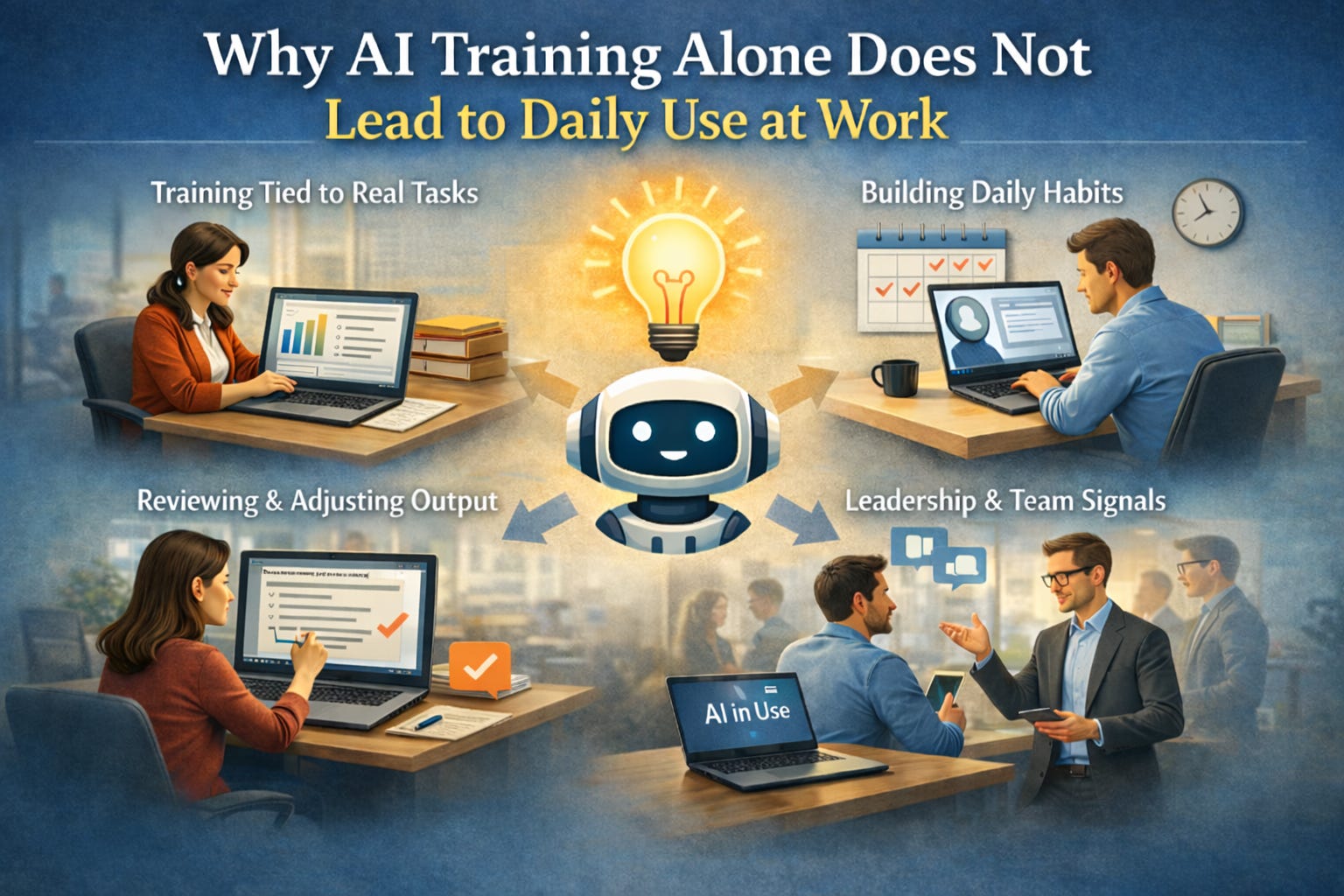
What separated consistent AI users from those who tried it once or twice wasn’t more tools or more training. It was four things working together.
Here’s what actually shaped regular AI use:
• Training that connects to real tasks
Not abstract examples, but guidance tied to work people already do.
• Habits built through repeated use
Small moments where AI shows up in the same place, again and again.
• Confidence in reviewing and adjusting output
People keep using AI when they trust their own judgment.
• Clear signals from leaders and teams
When managers and peers use AI openly, it feels normal and safe.
When all four were present, AI became part of everyday work.
When even one was missing, usage slowed down or stayed shallow.
This helps explain something many organizations experience:
strong training feedback, high attendance, positive surveys… and still limited use afterward.
Training builds capability.
Daily use grows through habits, confidence, and shared expectations.
📣 AI adoption grows through repeated actions inside real workflows.
For people leading AI, learning, product, or change efforts, this shifts where attention should go. The work is less about one-time rollouts and more about what happens after the training ends.
Instead of asking, “Did we train people?”
A more useful question is, “What makes it easy for them to use AI again tomorrow?”
That’s usually where progress starts.
I’ll leave you with one reflection:
Which of these four needs more attention in your organization right now: training relevance, habits, confidence, or leadership signals?
The answer often points to the next step.
Regarding the topic of the article, you've absolutely nailed why people don't actually use AI after all that expensive trainning, it's so frustratingly accurate.
Agree 100% with this view. Thank you for sharing the results and observations. The questions is How can you make people WANT to use AI, and not HAVE to use AI?
Nobody wants to “have to”