

AI Agents - Lesson 10: From Prototype to Production
Deployment, ROI, and Scaling


You made it! We are here… at the last lesson! You have been learning in the past 10 days how to build AI agents. Agents that automate tasks, answer questions, and orchestrate complex workflows. Your can now create demos that will wow people. But that's only the beginning. Because when you try to implement it at an enterprise level, one of the questions that you will have to answer is “What’s the ROI?” or “How do we know this is actually working?” and suddenly you’re scrambling for answers. You know it’s valuable, because you can feel it, but you don’t have numbers to back it up.
This is the final piece in our journey, where we can go from “cool prototype” to “business asset.” The difference here is about proving value, measuring impact, and scaling sustainably. This lesson gives you the framework to deploy agents confidently, measure what matters, and build a business case that gets buy-in from stakeholders.
Deployment: The Three-Phase Rollout
One of the biggest mistakes when deploying agents is to go live with everyone at once. That’s how agents fail spectacularly and kill trust. Instead of doing for that, I suggest that you use a phased approach, so here's a plan for a three-phase rollout:
Phase 1: Internal Pilot (Week 1-2)
Who: Your team only (5-10 people)
Goal: Find obvious bugs and usability issues
Oversight: Heavy - HITL (Human in the Loop) for almost everything
What to do:
Run the agent with test data first, then real data
Have team members use it for real tasks
Meet daily to discuss what’s working/broken
Fix critical issues immediately
Document everything that goes wrong
Success criteria:
Agent completes tasks without crashing
Team understands how to use it
You’ve fixed the worst bugs
You have confidence to expand
Phase 2: Friendly User Pilot (Week 3-4)
Who: 20-50 friendly users outside your team
Goal: Test with real users, real scenarios
Oversight: Medium - HITL (Human in the Loop) for risky actions, HOTL(Human on the Loop) for others
What to do:
Select users who are patient and will give feedback
Announce it’s a pilot (set expectations)
Make feedback really easy (Slack channel, daily survey)
Monitor daily, and be ready to help
Gather usage data and satisfaction scores
Success criteria:
70%+ of users say it’s helpful
Error rate under 10%
No major incidents
Users are starting to rely on it
Phase 3: Full Rollout (Week 5+)
Who: Everyone
Goal: Scale to full organization
Oversight: Mature - HITL (Human in the Loop) only for high stakes, most actions automated
What to do:
Announce broadly with training materials
Continue monitoring closely (first month)
Have support channel for questions
Iterate based on feedback
Reduce oversight gradually as confidence builds
Red flags that mean “pause”:
Error rate suddenly increases
Users complaining more than praising
Cost is exceeding projections
Security or compliance issues emerge
What to Measure: The Essential Metrics
You can’t measure everything, and trying will overwhelm you. Focus on these three categories:
1. Operational Metrics (Is it working?)
Track weekly:
Total actions: How many tasks did the agent handle?
Success rate: % completed without errors
Response time: How fast is it?
Uptime: Is it available when needed?
Example:
Week 1: 247 actions, 91% success, avg 12 seconds
Week 2: 389 actions, 94% success, avg 9 seconds
Week 3: 512 actions, 96% success, avg 8 seconds
What it tells you: The agent is getting more reliable and faster as you fix issues.
2. Business Impact Metrics (Is it valuable?)
Track monthly:
Time saved: Hours not spent on manual work
Cost savings: Money saved vs. previous process
Throughput increase: More work done in same time
Quality improvement: Fewer errors, higher satisfaction
Example - Customer Support Agent:
Before agent:
- 200 tickets/month
- Avg resolution time: 4 hours
- 75% customer satisfaction

After agent:
- 500 tickets/month (60% auto-resolved)
- Avg resolution time: 30 minutes
- 82% customer satisfaction

Impact:
- 150+ hours saved per month
- 2.5x throughput increase
- 7% satisfaction improvement
3. Cost Metrics (Is it sustainable?)
Track monthly:
API costs: LLM usage (OpenAI, Anthropic)
Platform costs: Make, Zapier, Copilot licenses
Human time: Time spent monitoring/correcting
Total cost per action: All costs ÷ actions completed
Example:
Monthly costs:
- OpenAI API: $450
- Make Pro: $29
- Human oversight: 10 hours × $50 = $500
Total: $979

Actions: 2,400 per month
Cost per action: $0.41

Previous manual cost per action: $12
ROI: 29x return
Calculating ROI: The Simple Formula
Executives only care about ROI(Return on Investment), and it is more difficult to reach than we think, but here’s one simple formula in how to calculate it:
ROI = (Value Generated - Cost to Run) ÷ Cost to Run × 100
Example 1: Content Creation Agent
Monthly Cost:
API usage: $200
Tools: $50
Monitoring: 5 hours × $75 = $375
Total: $625
Monthly Value:
Creates 20 blog posts
Previous cost: $300/post = $6,000
Value: $6,000
ROI: ($6,000 - $625) ÷ $625 × 100 = 860%
Example 2: Data Entry Agent
Monthly Cost:
API usage: $150
Zapier: $30
Setup/maintenance: $200
Total: $380
Monthly Value:
Processes 1,000 entries
Previous time: 1,000 entries × 3 min = 50 hours
Labor cost: 50 hours × $25 = $1,250
Value: $1,250
ROI: ($1,250 - $380) ÷ $380 × 100 = 229%
When ROI is Negative
Sometimes agents don’t pay for themselves (yet):
Still learning/training phase
Low volume use case
Expensive model for simple task
Too much human intervention required
What to do:
Optimize the agent (cheaper models, better prompts)
Increase usage (apply to more scenarios)
Reduce oversight (automate more)
Or... kill it if it’s not getting better
Building Your Business Case
When you need executive approval or budget, you’ll need to create slides to pitch your case. The most effective approach starts with a one-slide summary that covers six essential elements: the problem you’re solving, your proposed solution, the expected impact, the cost of implementation, the return on investment, and your risk mitigation strategy.
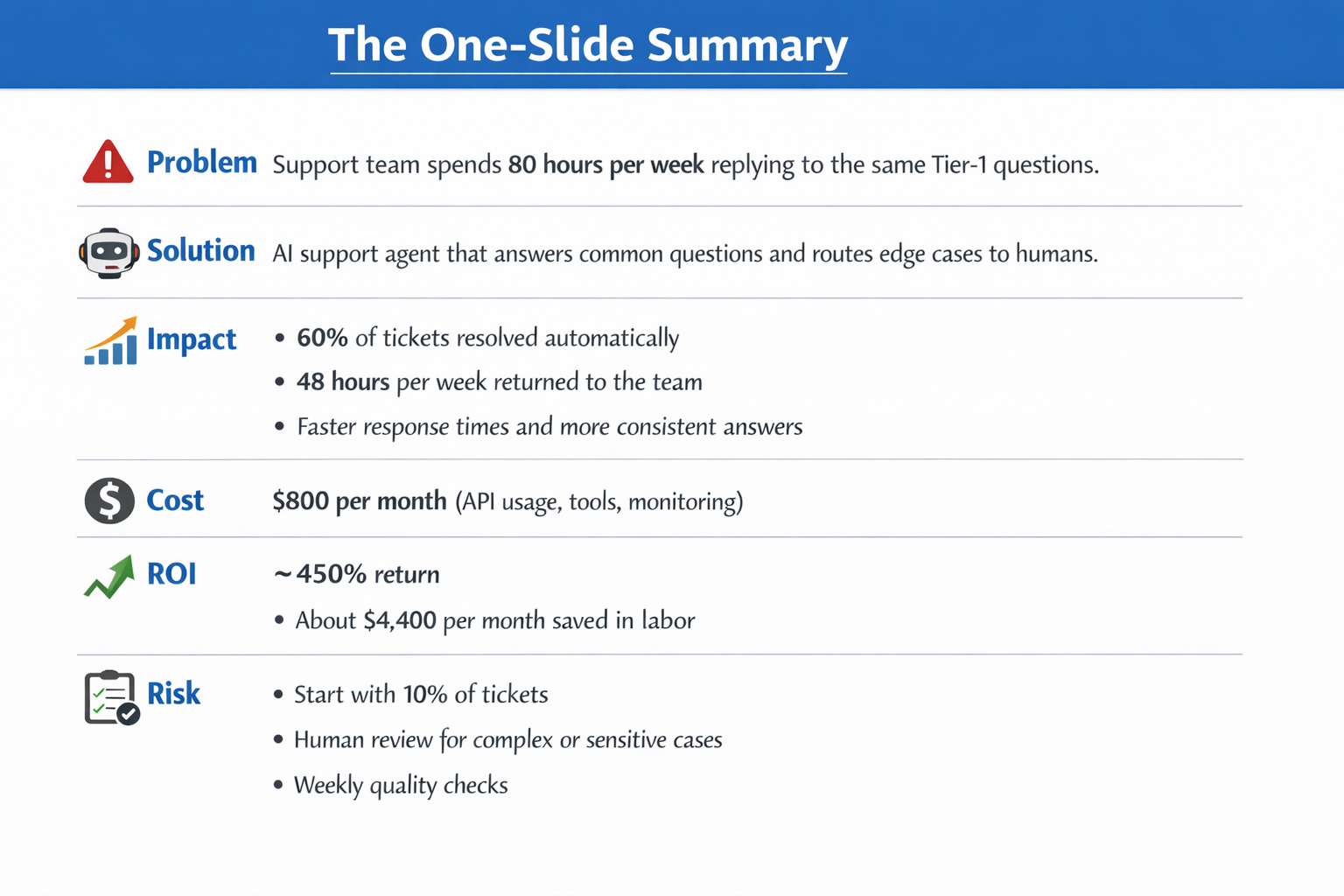
For example, imagine your support team spends 80 hours per week responding to repetitive ticket questions. Your solution is an AI support agent that handles tier-1 questions automatically, which would result in 60% of tickets being auto-resolved and 48 hours per week freed up for your team. The monthly cost might be $800 for API usage, tools, and monitoring, delivering an ROI of 450% by saving $4,400 per month in labor costs. To mitigate risk, you’d pilot the agent with just 10% of tickets first while maintaining human oversight for complex cases.
Beyond the summary, you need to answer three critical questions that executives will inevitably ask. First, “why now?” You need to demonstrate that the current process is breaking under increased volume or team overload, that the technology has matured beyond bleeding edge experimentation, and that your competition or industry is already moving in this direction. Second, “what’s the risk?” Address technical risks with clear mitigation strategies, security concerns with compliance measures, user adoption challenges with a change management plan, and potential cost overruns with budget controls. Third, “what if it fails?” Emphasize that you’re piloting first to limit risk, that you can roll back to manual processes if needed, and that even failure provides learning for your next attempt rather than wasted investment.
Scaling: From One Agent to Many
Once one agent succeeds, you’ll naturally want more. The key to scaling sustainably is managing your agents as a portfolio with clear tiers. Your Tier 1 consists of proven agents running in production, like customer support or data entry agents that have been operating for three months or more with validated ROI and minimal intervention needed. Tier 2 contains pilot agents in the testing phase, such as content creation or expense processing agents, which are running with small user groups while you’re still optimizing and building confidence. Tier 3 holds your experimental prototypes, like HR onboarding or sales research agents, which are in early testing with high oversight as you prove their feasibility.
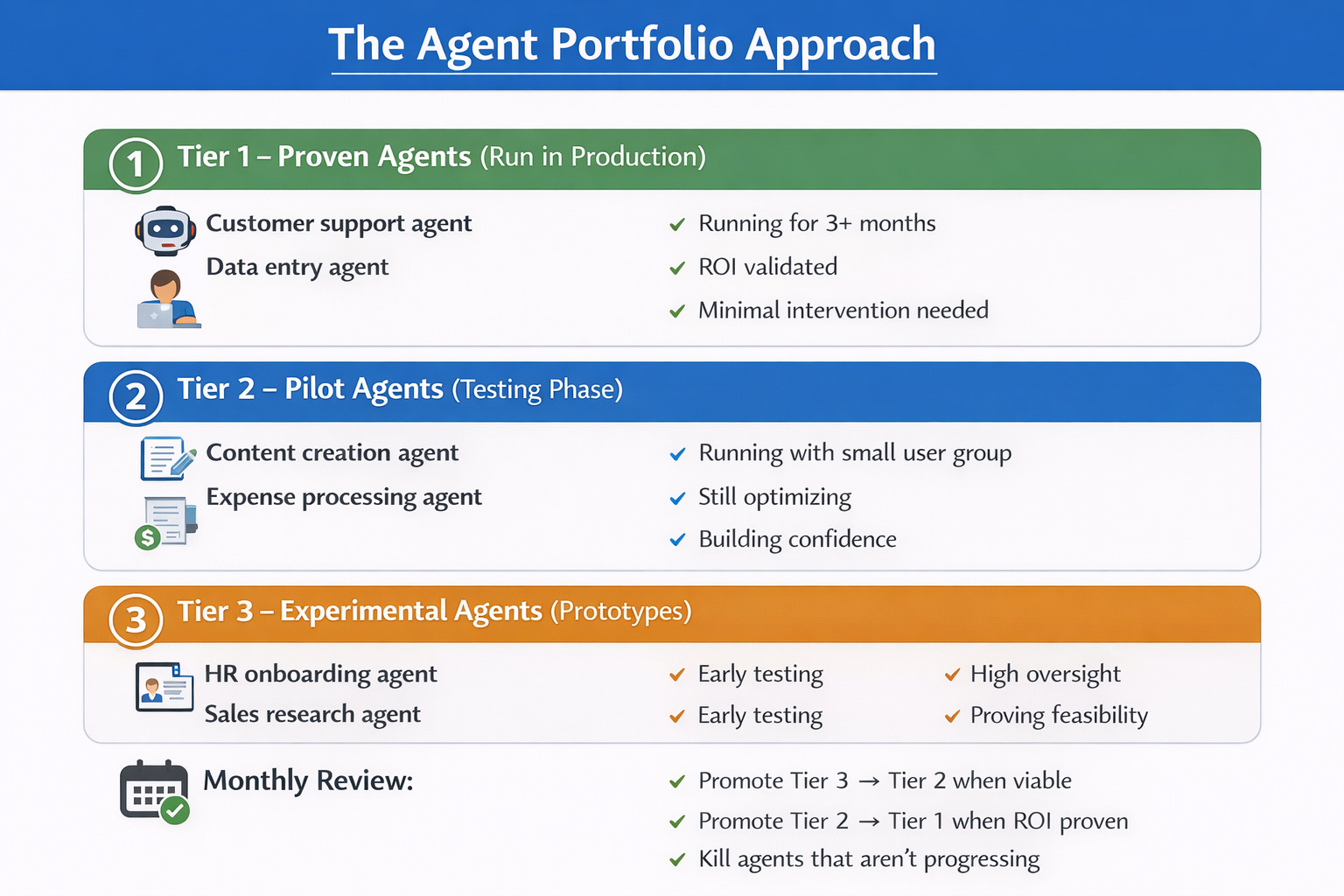
You should conduct monthly reviews to promote Tier 3 agents to Tier 2 when they prove viable, promote Tier 2 agents to Tier 1 when ROI is validated, and kill agents that aren’t progressing. This systematic approach prevents your agent portfolio from becoming an unmanageable collection of half-finished experiments.
As you scale, adopting a platform strategy becomes critical. Standardize on just one or two platforms, such as Make combined with Copilot Studio, rather than letting every team use different tools. This makes maintenance, training, and scaling much easier across your organization. Develop standard patterns by reusing successful workflows, creating templates for common agent types, documenting best practices, and sharing MCP servers across multiple agents. Finally, implement centralized monitoring with one dashboard for all agents, consistent metrics across your entire portfolio, a shared on-call rotation, and a knowledge base of solutions that grows with your experience.
When to Add Headcount
You should hire or assign a dedicated agent builder when you have around 5 or more production agents running, your requests backlog is growing faster than you can handle it, your current team is overwhelmed with maintaining existing agents, and the ROI clearly justifies the investment in a full-time role.
Consider bringing on a forward deployed engineer when you need someone deeply embedded with business teams who can provide domain-specific customization for your agents. This role is particularly valuable when there’s resistance to adoption that requires hands-on support, when quick iteration cycles with end users are critical to success, or when you need someone who can translate business needs into technical requirements in real-time while working directly alongside stakeholders.
However, don’t hire too early in your agent development journey. Start with side-of-desk efforts where existing team members explore agent possibilities alongside their regular work. Prove the value of agents first through these initial experiments, and only then formalize dedicated roles. Forward deployed engineers work best once you have proven use cases to scale and refine, rather than using them to discover use cases from scratch.
Common Pitfalls and How to Avoid Them
Some of the lessons learned from teams building agents that you can avoid in your own development and deployment.
Pitfall 1: Building for Perfection
The mistake: Spending months perfecting an agent before anyone uses it
The fix: Ship it at 80% with heavy oversight, improve based on real usage
Pitfall 2: No Clear Owner
The mistake: Agent is “everyone’s responsibility” so becomes no one’s
The fix: Assign one person as owner, accountable for performance and maintenance
Pitfall 3: Set It and Forget It
The mistake: Deploy agent, never check on it again until something breaks
The fix: Weekly check-ins first month, bi-weekly after, monthly once mature
Pitfall 4: Measuring Everything
The mistake: 50 metrics in a dashboard, no one looks at it
The fix: 5-10 key metrics you actually review and act on
Pitfall 5: No Failure Plan
The mistake: Agent breaks, chaos ensues, no backup process
The fix: Document manual fallback process, keep it ready
Your 90-Day Roadmap
Here an example to get from your pilots to production.
Month 1: Prove It Works
Week 1-2: Internal pilot, fix obvious issues
Week 3-4: Friendly user pilot, gather feedback
Deliverable: One working agent with 70%+ satisfaction
Month 2: Prove It’s Valuable
Week 1-2: Track metrics, calculate ROI
Week 3-4: Document business case, get stakeholder buy-in
Deliverable: ROI documented, next agent approved
Month 3: Prove It Scales
Week 1-2: Full rollout of first agent, reduce oversight
Week 3-4: Start second agent using lessons learned
Deliverable: First agent in mature production, second agent piloting
By Day 90: You have a proven playbook for building, deploying, and scaling agents
Takeaways
Phase your rollouts. Internal pilot → Friendly users → Full rollout. This catches issues early and builds trust gradually.
Measure what matters. Track operational metrics (is it working?), business metrics (is it valuable?), and cost metrics (is it sustainable?). Everything else is noise.
Calculate ROI early and often. Executives need numbers. Value generated minus cost to run, divided by cost to run. If you can’t show ROI by month 2-3, re-evaluate.
Scale deliberately. Maintain a portfolio of agents at different maturity levels. Standardize tools and patterns. Add headcount only when ROI justifies it.
Plan for failure. Have rollback plans, manual fallbacks, and clear owners. Things will break—be ready.
The magic number is 10x. If your agent isn’t saving 10x its cost in time or money, it’s probably not worth the maintenance burden. Aim higher.
What’s Next: Your Agent Program
You now have the complete playbook. Across 10 lessons, you’ve learned how to build a complete framework for production AI agents:
Lessons 1: What is an AI Agent?
Lessons 2: When to build Agents?
Lessons 3: Types of Agents and How they work
Lessons 4: Building agents without coding: simple automations with GPTs, Gems and Copilot Studio Lite
Lessons 5: Build agents with Make, Zapier, Relay, Copilot Studio Full
Lesson 6: Give them memory (RAG)
Lesson 7: Orchestrate multiple agents (LangChain, LangGraph, CrewAI)
Lesson 9: Systematically improve quality (Evals)
Lesson 10: Deploy and measure business impact (ROI) (this one!)
Your mission for the next 90 days:
In your personal life…
Start creating a GPT, Gems or Copilot Studio Lite to enhance your productivity
Try then to create an AI automation with Make, Zapier or Relay.
Find the next workflow that should be automated or could become an agent.
In your professional life:
Pick your highest-impact use case
Build the agent following the patterns from this course
Deploy using the three-phase rollout
Measure religiously and calculate ROI
Use success to fund the next agent
The ultimate goal: A portfolio of reliable agents that collectively save you, or your organization hundreds of hours per month, with proven ROI and executive support for expansion.
Thank you for making to the end of this course. Now, share this course with friends and I will have a surprise for you. Once we reach 1000 subscribers here in this Substack, I will give all of you a copy of these 10 lessons in a ebook format so you can have it handy.

We finished the course, but I will continue to share valuable information in this newsletter every week.
The best AI agents don’t replace humans—they amplify them. Their real power isn’t autonomy, but alignment with human intent, context, and judgment.
Really valuable breakdown